
The RBI had been widely expected to lift its repo rate by 25 basis points, but instead opted to keep the country's main lending rate at 7.75 per cent.
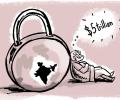
Chief Economic Advisor V Anantha Nageswaran on Thursday expressed hope that the economy will maintain the trend growth rate of 6.5 per cent and above for the rest of the years in the current decade. The economy will close the current fiscal logging in a growth of 6.5-7 per cent, he said, citing the projections of private sector analysts, Reserve Bank of India (RBI) and international agencies like OECD and the IMF. "This appears to be reasonable at this point in time although we will get the data on the fiscal second quarter in a few days, which will give more clarity on these numbers.
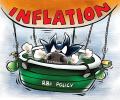
The Reserve Bank of India on Friday raised the retail inflation target for the current financial year to 5.7 per cent on the back of rising global prices amidst the ongoing geo-political tensions, even as it expected the prices of cereals and pulses to soften on prospects of good winter crop harvest. "Global food prices along with metal prices have hardened significantly. "Economy is grappling with a sharp rise in inflation... Inflation is now projected at 5.7 per cent in 2022-23 with Q1 at 6.3 per cent; Q2 at 5 per cent; Q3 at 5.4 per cent and Q4 at 5.1 per cent," RBI Governor Shaktikanta Das said while unveiling the first monetary policy review for the current fiscal year.

The Reserve Bank on Wednesday hiked key benchmark policy rate by 25 basis points to 6.5 per cent, citing sticky core inflation. This is the sixth time interest rate has been hiked by the Reserve Bank of India (RBI) since May last year, taking the total quantum of hike to 250 basis points. Announcing the bi-monthly monetary policy, RBI Governor Shaktikanta Das said the Monetary Policy Committee (MPC) by a majority decided to raise the policy repo rate by 25 basis points and keep a 'strong vigil' on inflation outlook.

The Indian services sector activity fell to a six-month low in September, as new business inflows rose at the slowest rates since March, amid inflationary pressures and competitive conditions, a monthly survey said. The seasonally adjusted S&P Global India Services PMI Business Activity Index fell to 54.3 in September, from 57.2 in August, highlighting the weakest rate of expansion since March. For the fourteenth straight month, the services sector witnessed an expansion in output. In Purchasing Managers' Index (PMI) parlance, a print above 50 means expansion, while a score below 50 denotes contraction.

Shiv Sena leader Eknath Shinde will be the new chief minister of Maharashtra, Bharatiya Janata Party leader Devendra Fadnavis said on Thursday.
'Vote banks will change affiliations and the BJP will come out with good success in Kerala.'
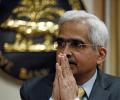
Uncertainty is emerging as the only certainty, said RBI Governor Shaktikanta Das as he emphasised on continued policy support at the December MPC meet during which members expressed concerns over spread of the Omicron variant of coronavirus, as per the minutes of the rate-setting panel released on Wednesday. After three days of deliberations, the six members of the Monetary Policy Committee (MPC) on December 8 unanimously voted for status quo on policy rates for the ninth consecutive time. At the meeting, the RBI Governor said risks stalking the global economy have amplified with rapid spread of the virus mutations, including the Omicron variant, leading to countries scrambling for restrictions.
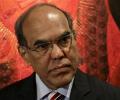
Subbarao said, short-term as well as medium-term prospects or Indian economy continue to be grim. Fiscal deficit is going to be much higher, the debt burden much larger and the financial sector will be in a worse shape.

Amid signs of increasing bonhomie between her and her Telangana and Tamil Nadu counterparts Rao and Stalin, Banerjee had approached the two on Sunday to set up meetings of opposition chief ministers.

The criticism that the Reserve Bank of India was behind the curve in hiking interest rate to tame rising inflation is unfair, former RBI Governor D Subbarao said on Wednesday and asserted that it is difficult for any central bank to anticipate the future more accurately. Earlier this month, Monetary Policy Committee (MPC), the central bank's rate-setting panel, surprised the markets with a 40 basis points hike in repo rate in an off-cycle policy meeting. It was also the first rate hike after August 2018, amid spiralling inflation.
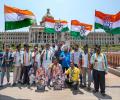
The DMK leadership may now have to deal with a demand for more seats from its Congress ally in the Lok Sabha polls, predicts N Sathiya Moorthy.

The party also rejigged its Central Election Committee and included former Maharashtra chief minister Devendra Fadnavis, Union Minister Bhupender Yadav, Om Mathur and its women wing chief Vanathi Srinivasan.

However, the RLD leader gave a terse response. 'Invite those +700 farmer families which you have destroyed, not me,' he tweeted in Hindi.

India's services sector activities eased to a three-month low in April, as the rise in business activity was constrained by the pandemic and sentiment towards growth prospects faded, a monthly survey said on Wednesday. The seasonally adjusted India Services Business Activity Index fell to 54 in April from 54.6 in March, the slowest increase in output in three months. In PMI parlance, a print above 50 means expansion while a score below 50 denotes contraction.

Spiralling prices pinched the pocket of consumer as edible oil, fuel and many other commodities turned dearer this year amid pandemic-induced disruptions but the inflationary pressure is anticipated to ease, though marginally, in the coming months. As consumers, at retail as well as wholesale levels, are willy-nilly learning to live with the new normal of curbs to contain the spread of coronavirus infections, experts are of the view that elevated inflation is likely to stay longer. After dealing with the devastating blows from the second COVID wave, especially during the April-June period, the economy is well on the revival path but the emergence of Omicron might unsettle the recovery trajectory in the short term.

The RBI on Friday said the impact of coronavirus outbreak on the economy will depend on the intensity, spread and duration of the deadly virus even as the central bank refrained from projecting any numbers for growth and inflation amid the widespread uncertainty. While announcing the seventh bi-monthly monetary policy statement for 2019-20, RBI Governor Shaktikanta Das said that in view of the impact of coronavirus pandemic, the growth projections for 4.7 per cent for the fourth quarter of 2019-20 and 5 per cent for the full fiscal are "now at risk".
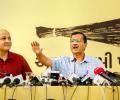
'The BJP is scared it may lose the Delhi municipal elections where they have been in power for the last 15 years.'

The Reserve Bank on Friday projected retail inflation to be in 5-5.2 per cent range during the first half of the next fiscal year, expecting further softening of vegetables prices in near term. Also, it has lowered the retail inflation forecast for the current January-March quarter of 2020-21 fiscal at 5.2 per cent. The Reserve Bank (RBI) has kept the key policy rate unchanged at 4 per cent, with an accommodative stance, so as to ensure that inflation remains well within the target, Governor Shaktikanta Das said while announcing the last monetary policy of 2020-21.

With the Budget-making exercise in full swing, RBI Governor Shaktikanta Das on Friday said Budget 2021-22 is expected to be prudent and growth oriented. Das before donning the hat of RBI Governor was a career bureaucrat and was directly involved in crafting of about 10 Budgets for the country including one in the aftermath of global financial meltdown in different capacities at the finance ministry. In view of unprecedented pandemic and its impact on the economy, he said the government has maintained fiscal prudence in the response to deal with the crisis.

The Reserve Bank on Friday retained the GDP forecast for the current financial year at 9.5 per cent and flagged global semiconductor shortages, elevated commodity prices and potential global financial market volatility as downside risks to economic growth. In his address after the three-day meeting of the rate-setting panel, RBI Governor Shaktikanta Das said recovery in aggregate demand gathered pace in August-September, and it is reflected in high-frequency indicators, like railway freight traffic; port cargo; cement production; electricity demand; e-way bills; GST and toll collections. "The ebbing of infections, together with improving consumer confidence, has been supporting private consumption," he said, and added the pent-up demand and the festival season should give further fillip to urban demand in the second half of the financial year.

The petitioners alleged that the governor has acted in a "partisan manner" and allowed himself to be a "pawn in the BJP's illegal usurpation of power".

Law Minister Kiren Rijiju on Saturday claimed that a few retired judges and some activists who are 'part of the anti-India gang' are trying to make the Indian judiciary play the role of the opposition party.

Stressing that economic growth will only move upwards, the Reserve Bank of India Governor Shaktikanta Das on Friday pegged the GDP growth rate for the next financial year at 10.5 per cent, though a tad lower than the government's projection of 11 per cent. The projection is in line with the estimates in the Union Budget 2021-22 presented in Parliament earlier this week. The Economic Survey, tabled by the government in Parliament recently, has projected that the economy will grow at 11 per cent, up from an estimated historic decline of 7.7 per cent in 2020-21, on account of the COVID-19 pandemic.

India's manufacturing sector activities moderated in August, as business orders and production rose at softer rates due to the pandemic and rising input costs, a monthly survey said on Wednesday. The seasonally adjusted IHS Markit India Manufacturing Purchasing Managers' Index (PMI) stood at 52.3 in August, down from 55.3 in July, indicating a softer rate of growth that was subdued and below its long-run average. The August PMI data pointed to an improvement in overall operating conditions for the second straight month.
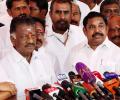
There is a sudden realisation in party circles that prolonged court cases could damage its standing, both among the cadres and voters, observes N Sathiya Moorthy.
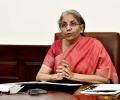
The Centre will release Rs 95,082 crore as tax devolution to the states this month after including one advance instalment to help them push their capital expenditure, Finance Minister Nirmala Sitharaman said on Monday. After a meeting with all chief ministers and state finance ministers, Sitharaman said states had said that it would be helpful for them if the tax devolution is front loaded.
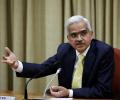
The Reserve Bank remains laser-focused to bring back retail inflation to 4 per cent over a period of time in a non-disruptive manner, Governor Shaktikanta Das stressed while voting for status quo in interest rates, as per minutes of the October policy meeting released on Friday. The central bank has been mandated by the government to ensure the Consumer Price Index (CPI) based inflation is at 4 per cent, with a band of 2 per cent on either side. The retail inflation, which was above 6 per cent during May and June, has started moving down and stood at 4.35 per cent in September.

After selling dollars for the past few months, the Reserve Bank of India (RBI) may take a hands-off approach before its annual account closing by not trying to prop up the rupee as geopolitical tensions show signs of stabilising with global crude oil prices easing from its $140 peak. The central bank was a net buyer of dollars between April and September, and then turned a net seller in the following months, the data released by the RBI showed. The RBI continued to be a net buyer of $36.6 billion in this fiscal year - between April and January. In 2020-21, it purchased $68 billion on a net basis.
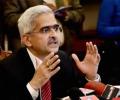
Reserve Bank Governor Shaktikanta Das has pitched for policy support from all sides -- fiscal, monetary and sectoral -- to nurture recovery of the economy hit by the second wave of the coronavirus pandemic. The dent on economic activity due to the second wave of the pandemic during April-May necessitated continuation of monetary measures to support the process of economic recovery to make it durable, Das had said while participating in the meeting of the Monetary Policy Committee (MPC) earlier in the month. "Overall, the second wave of COVID-19 has altered the near-term outlook, and policy support from all sides - fiscal, monetary and sectoral - is required to nurture recovery and expedite return to normalcy," Das said, as per the minutes of the meeting released on Friday.

The sweeping economic sanctions on Russia - the second largest producer of crude oil - following its invasion of Ukraine late last month can cull global and domestic growth along with the added pains of higher inflation and currency depreciation, RBI Deputy Governor Michael Patra has said. And if the war lingers on, it can even lead to deglobalisation and even a recession, he added. The ongoing war has only added a whole new dimension to the outlook, and in fact, a weighty downside, Patra said in a lecture at the industry lobby IMC on Friday evening.

"Stalin is the future of the party," said late Dravida Munnetra Kazhagam patriarch M Karunanidhi about six years ago at a party meet when his son was party treasurer.

'Although Hong Kong weathered many a storm and displayed a remarkable resilience to bounce back, the developments in the territory have raised question marks with regard to its future stability and prosperity.' A revealing excerpt from Rup Narayan Das's Hong Kong Conundrum: Pangs of Transition.

The Congress may stand a better chance in the assembly polls if it followed the 'Himachal model', suggests N Sathiya Moorthy.

While the Constitution makes everyone in India eligible to work anywhere in the country, states have used legal loopholes to frame laws.

Unemployment, delivery of justice in desecration cases, illegal sand mining and drug menace are likely to be key issues in the Punjab assembly elections.
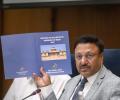
Setting in motion the process for the 16th presidential election, the Election Commission on Thursday said anyone desiring to contest would need 50 electors as proposers and 50 others as seconders -- a move aimed at weeding out non-serious candidates in these polls that once saw nominations getting rejected for 36 out of 37 candidates.

The Reserve Bank's growth projection for next financial year is lower than 8-8.5 per cent projected by the finance ministry in the recent Economic Survey which was tabled in Parliament on January 31. Unveiling the bi-monthly policy, RBI governor Shaktikanta Das said, "Recovery in domestic economic activity is yet to be broad-based, as private consumption and contact-intensive services remain below pre-pandemic levels."

With several political stalwarts of Uttar Pradesh no longer on the scene, it will be keenly watched how their children lead at the hustings this time without their formidable presence.
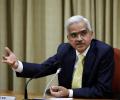
The Reserve Bank of India (RBI) on Friday decided to leave the benchmark interest rate unchanged at 4 per cent but maintained an accommodative stance, implying rate cuts in the future if need arises to support the economy hit by the Covid-19 pandemic.
